


From Pet Care to Marine Conservation: Chilean Technology Adapted to Help Rehabilitate Penguins


The collaboration seeks to adapt Copperbody® textile technology, originally developed for veterinary applications, to the needs of injured penguins admitted to rehabilitation centers. The initiative is currently in the development and evaluation stage.
CHILE, SEPTEMBER 2026. - An innovative collaboration between Kimbavet and the NGO Conservación Humboldt is exploring new alternatives to support the recovery of rescued penguins admitted to rehabilitation centers after suffering injuries.
The initiative aims to adapt Copperbody®, a textile technology developed in Chile by Kimbavet, to the specific needs of penguins undergoing rehabilitation. The goal is to develop a garment capable of protecting wounds and supporting the recovery process of these wild animals.
The project emerged from a specific need identified by the Conservación Humboldt team, an organization dedicated to the conservation and rehabilitation of protected marine wildlife. Many of the penguins admitted to its centers have wounds on areas such as their chest or back caused by different circumstances, including attacks by other animals or accidents involving boats.
These injuries require cleaning, treatment and, in some cases, stitches. Like domestic animals, penguins can also interfere with their own wounds, peck at them or even pull out their stitches, making recovery more difficult.
Follow us on: 
"The problem is that these animals cannot be bandaged for long periods and, in addition, they can peck at the wound, irritate it or pull out the stitches. So, we needed a way to isolate the wound and prevent them from causing themselves further harm," explains Dr. Tomás Pino Damke, President of Conservación Humboldt.
From a pet solution to wildlife
Faced with this challenge, the teams began exploring the possibility of adapting a textile technology already used for pets to the anatomical and behavioral characteristics of penguins undergoing rehabilitation.
The solution identified was Copperbody®, a garment developed by Kimbavet that incorporates textile technology with copper and zinc and has been used primarily in domestic animals such as dogs and cats.
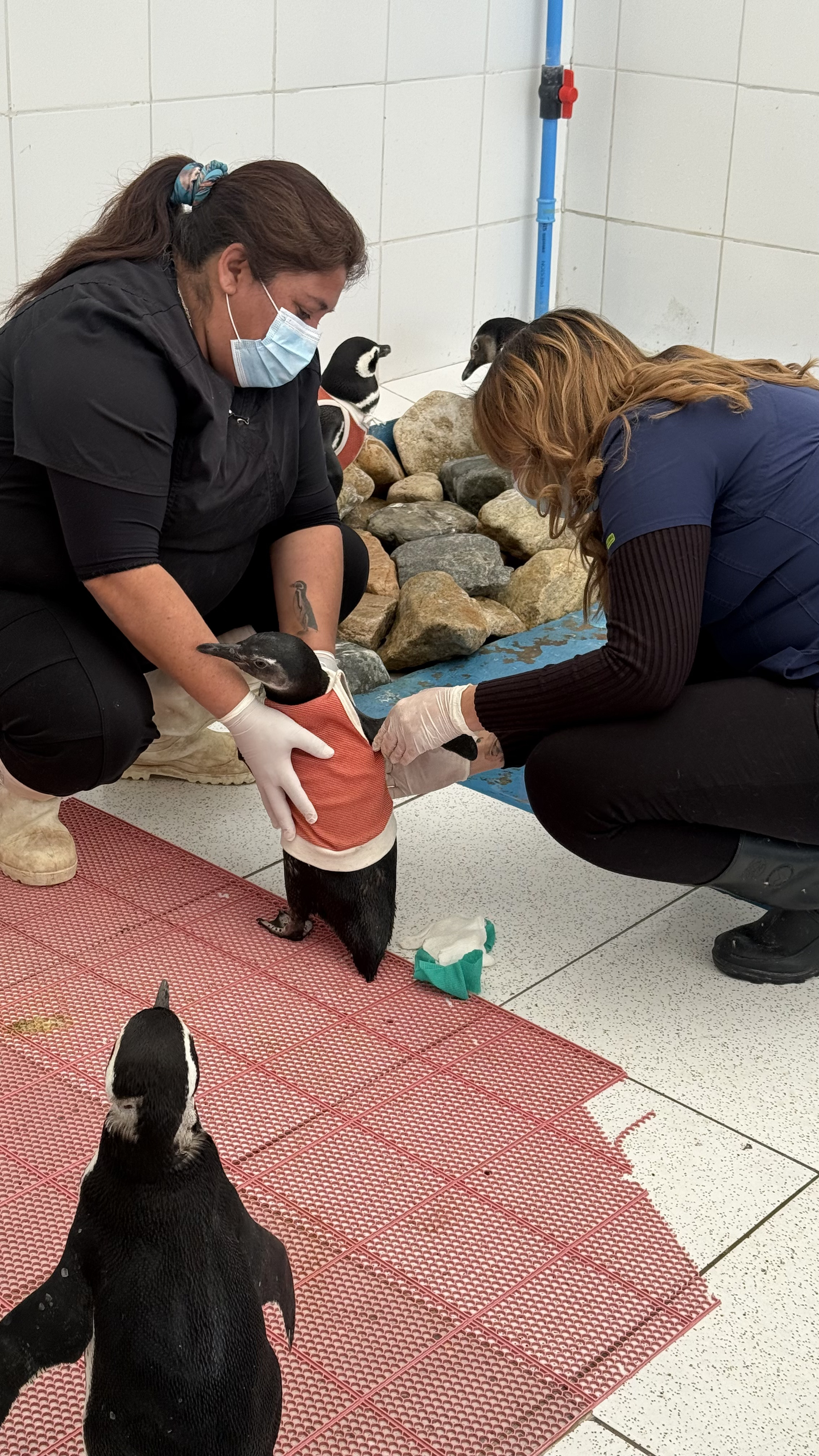
"This collaboration began when Dr. Tomás Pino Damke contacted us with the idea of developing a Copperbody® garment adapted to the anatomy of penguins. We loved the challenge and, from that moment on, we have put our experience and resources into this development, because we believe innovation also means taking an existing solution and asking how it can be adapted to address a completely different need," says Adolfo Momares, Director at Textil Kimba.
According to Momares, the challenge involves transferring the experience accumulated in post-surgical garments for domestic animals to a completely different setting, taking into account the physical characteristics, behavior and specific conditions of wild animals undergoing rehabilitation.
An alliance of complementary expertise
The collaboration brings together Conservación Humboldt’s expertise in marine wildlife rehabilitation and Kimbavet’s knowledge in developing and adapting textile solutions for veterinary applications.
Founded in La Serena in 2015, Conservación Humboldt works to protect and rehabilitate different species of marine wildlife, including penguins, sea turtles and sea lions.
"For us, this type of collaboration is very important because it allows us to explore new alternatives to problems we face directly during animal rehabilitation. Having a specially adapted garment could become a complementary tool to protect wounds and support recovery, but we are currently only at the development and evaluation stage," says Dr. Tomás Pino Damke.
The project is currently in an initial phase of design, adaptation and evaluation. The goal is to develop a garment that meets the needs of penguins undergoing rehabilitation and subsequently assess its performance, functionality and potential usefulness within these processes.
The first stage of development included the collaboration of Buin Zoo, which provided a penguin for an initial fitting test. The work subsequently continued between the NGO Conservación Humboldt and Kimbavet, enabling further progress in the exploration, research and adaptation of the garment.
Innovation driven by a real need
The development of Copperbody® began in 2015, and the innovation is currently present in more than 40 countries. However, its potential application in penguins represents a new area of exploration for Kimbavet.
"This is not simply about taking a garment that works for dogs or cats and putting it on another animal. There is significant work involved in adaptation, design and learning. We need to understand the specific needs of penguins and carefully evaluate how the garment performs during their rehabilitation process. It is a journey that is just beginning, but we are very excited about the possibilities opened up by this collaboration with Conservación Humboldt," says Adolfo Momares.
Both organizations emphasize that the initiative is still at an early stage and that a significant process of testing and evaluation remains before the potential scope of the solution can be determined.
Beyond developing a new garment, the collaboration seeks to demonstrate how connecting different areas of expertise can open new possibilities for addressing specific challenges.
"Innovation often emerges precisely from looking at a problem from a different perspective. This partnership allows us to bring together different areas of expertise and explore whether a technology developed for one veterinary application can also contribute to wildlife recovery processes," Momares concludes.
The initiative therefore opens a new avenue for exploring how veterinary technology can be adapted to the needs of wild animals, with a focus on developing tools that could complement marine wildlife rescue, rehabilitation and conservation efforts.
The collaboration is driven by a broader purpose: everything being developed is ultimately intended to contribute to species conservation, particularly the conservation of the Humboldt penguin.
In addition to developing a new garment, the collaboration seeks to demonstrate how innovation and the integration of different areas of expertise can help address specific challenges in wildlife rehabilitation. Adapting new technologies to these processes could help improve recovery techniques for injured animals and, in turn, strengthen the tools available for the rehabilitation of different penguin species.
This challenge is particularly relevant for species such as the Humboldt penguin, a threatened species characteristic of the Humboldt Current along the western coast of South America. In this context, developing new tools to improve the care and recovery of injured individuals could contribute to broader efforts to conserve their populations.
The initiative thus opens a new avenue for exploring the adaptation of veterinary technology to the needs of wild animals, with the aim that innovation developed in response to a specific rehabilitation challenge could eventually become a complementary tool for the conservation of threatened species.