


Chilean scientists discover how to dismantle a key molecule in stomach and breast tumors


A team from Universidad Andrés Bello (UNAB) used CRISPR to remove a tiny fragment of MALAT1 RNA, a molecule that plays a key role in gastric and breast cancer. By doing so, the researchers managed to destabilize the entire molecule and slow tumor progression.
SEPTEMBER 2026.- Inside our cells, there are RNA molecules that, while performing normal biological functions, can also become allies of cancer. One of the most widely studied is MALAT1, an RNA molecule that can act as a driver helping tumor cells survive and multiply more rapidly.
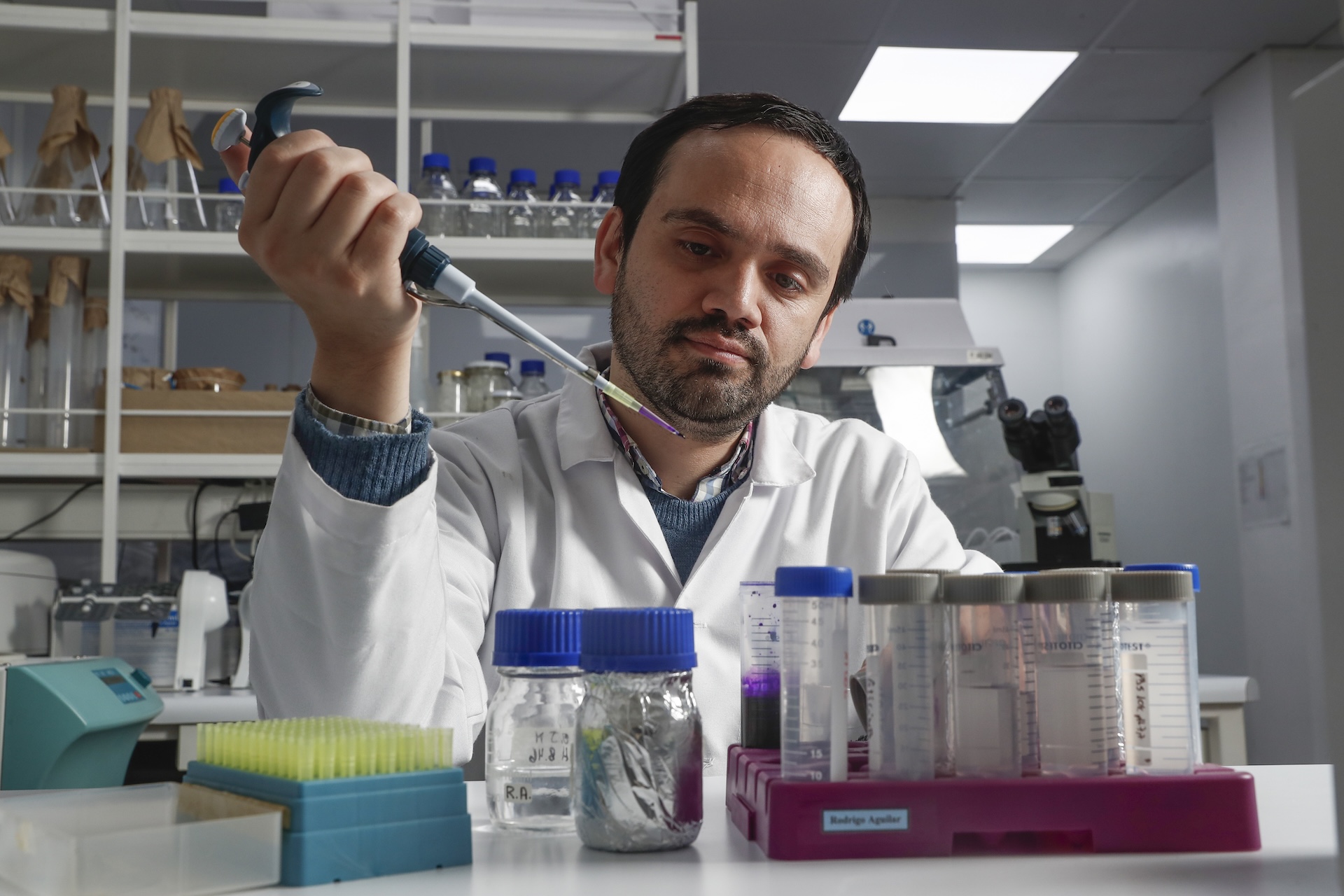
However, a team from the Institute of Biomedical Sciences at Universidad Andrés Bello (UNAB), led by researcher Rodrigo Aguilar, has identified a potential vulnerability in this molecule. Using laboratory models of stomach and breast cancer, the researchers were able to completely destabilize MALAT1 by removing only a tiny fragment of its structure.
A meticulous process
To achieve this, the team used CRISPR-Cas9, the technology often described as "molecular scissors" because it allows scientists to precisely edit genetic material. Unlike previous research, which had studied this region of MALAT1 only in test tubes, the UNAB team carried out the modification directly in living cells.
Follow us on: 
"We removed the fragment in living cells and discovered that, by taking out this tiny piece, the entire MALAT1 molecule fell apart and lost its function. This shows that this small segment acts as a pillar supporting this cancer-associated RNA," Aguilar explains.
The scale of the discovery becomes clearer through a comparison proposed by the researcher himself.
"If we imagined MALAT1 RNA as a giant word made up of 7,400 letters, we used CRISPR scissors to remove only 10 to 40 of those letters. We expected to see some effect, but not that such a tiny alteration would cause the entire molecule to collapse," he says.
According to Aguilar, this was one of the study’s most unexpected findings, leading him to describe this small region as MALAT1’s "Achilles’ heel."
Cancer cells stopped multiplying and began to die
The effects were not limited to the RNA molecule itself. After removing this fragment, the modified cancer cells showed a dramatic change in behavior.
"First, we observed that the cancer cells lost their ability to divide rapidly," Aguilar says.
Using flow cytometry, a technique that makes it possible to analyze the condition of cells individually, the team confirmed that the effect went beyond simply slowing their growth.
"We demonstrated that the cells had not only stopped multiplying, but were also dying at a much higher rate compared with cells that had not been modified. By removing this key piece, we left them unprotected," the researcher explains.
From laboratory cells to a potential treatment
Although the study was conducted using laboratory models, its findings could contribute to the development of future treatments. Aguilar explains that research groups around the world are already working on drugs designed to block the same region of MALAT1 that his team removed.
"What our study provides is biological proof that targeting this exact site in living cells really works. Our results provide the scientific evidence needed for the biomedical industry to continue advancing in the development of drugs or gene therapies directed at this target," he says.
However, the path toward a treatment that can be made available to patients is still a long one. According to Aguilar, before clinical trials in humans can be considered, the strategy must first be validated in human tumors and researchers must rule out potential unwanted effects on healthy tissue.
"This entire process usually takes between five and ten years, but every discovery like ours is an essential step toward shortening that distance," Aguilar says.
The researcher also emphasizes that the breakthrough was not the work of a single laboratory.
"This advance was made possible thanks to the collaborative work of three research groups from UNAB’s Institute of Biomedical Sciences, a team from the University of Chile, and the valuable collaboration of colleagues from Spain and the United States, together with the tremendous dedication of our students," he says.
For Aguilar, the findings also carry significance beyond the scientific results themselves.
"It is concrete proof that in Chile we can produce research with international impact when we combine capabilities and work as a team," he concludes.